What's in this guide (skip to what you need)
I still remember my first 20-gallon tank. I filled it with tap water, added dechlorinator, dropped in six neon tetras, and watched them die one by one over four days. The water looked crystal clear. The test kit said ammonia was off the charts. That's when I actually learned the aquarium nitrogen cycle explained in a way that stuck — not from a textbook, but from a trash bag full of dead fish. Since then, I've cycled over thirty tanks. Let me save you the trash bag.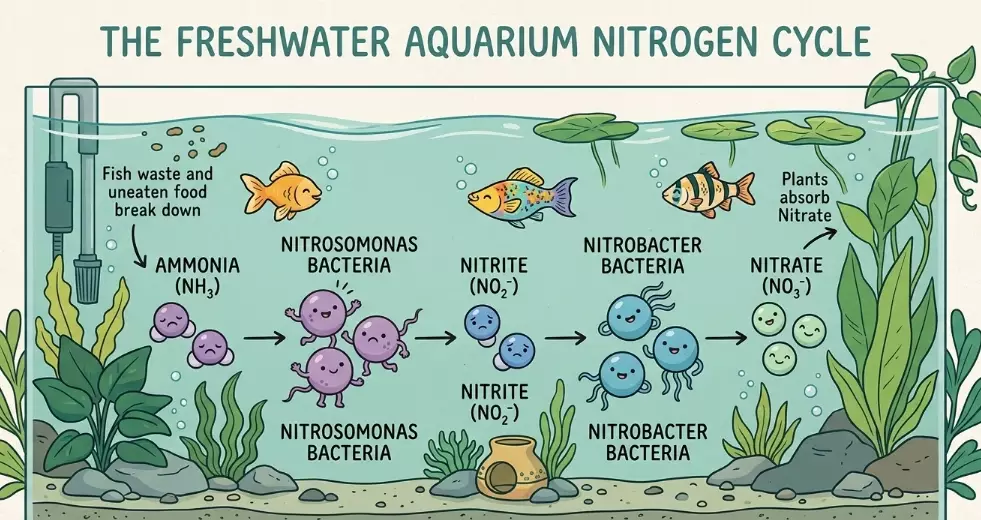
What Is the Aquarium Nitrogen Cycle, Really?
Forget the textbook diagram for a second. The nitrogen cycle in your tank is just a chain of bacteria doing janitorial work. Fish pee and poop, leftover food rots, and all that organic waste breaks down into ammonia (NH₃). Ammonia is the villain here — it burns gills and kills fast. Then one group of bacteria (Nitrosomonas) eats ammonia and turns it into nitrite (NO₂⁻). Still toxic. Then a second group (Nitrobacter) eats nitrite and turns it into nitrate (NO₃⁻). Nitrate is much less toxic. Plants use it. You remove the rest with water changes.
That's it. Three chemicals, two bacterial teams, one goal. The cycle isn't a circle you draw. It's a bacterial population that has to grow large enough to match your fish's waste output. That takes weeks, not days — no matter what a bottle label tells you.
The non-consensus detail: Many guides tell you to "feed" the cycle with fish food or pure ammonia. Both work. But I've found pure ammonia (the kind with no surfactants, no perfume) gives you a cleaner test reading and less phosphate buildup than rotting fish food. Fish food adds organics that fuel algae later. If you can get pure ammonia, use it.
The Three Stages and What You'll Actually Test
I keep a spreadsheet for every tank I cycle. Here's what the numbers look like when things go right, using a liquid test kit (strips lie too often).
| Stage | Ammonia (ppm) | Nitrite (ppm) | Nitrate (ppm) | What's happening | Action |
|---|---|---|---|---|---|
| Start (day 1-3) | 2-4 | 0 | 0 | Bacteria colonizing, ammonia rising | Dose ammonia to 2 ppm, wait |
| Peak ammonia (day 5-10) | 4+ | 0.25-1 | 0 | Nitrosomonas waking up | Don't panic, don't dose more |
| Nitrite spike (day 10-20) | 0-0.5 | 5+ (off chart) | 5-10 | Nitrobacter growing, nitrite high | Water change if nitrite >5 ppm |
| Nearly done (day 20-30) | 0 | 0.25 | 20-40 | Both bacteria teams established | Dose ammonia to 2 ppm, retest in 24h |
| Cycled (day 30+) | 0 | 0 | 10-40 | Ammonia clears in 24h | Big water change, add fish slowly |
See the nitrite peak? That's where most people give up. Nitrite takes the longest to drop because Nitrobacter reproduces slower than Nitrosomonas. I've had tanks sit at 5 ppm nitrite for twelve days. The water looks fine. The fish (if you have any) look fine. Then one morning you test and it's zero. Patience wins.
How to Cycle a Fish Tank Without Losing Fish
You've got two roads: fishless or with fish. I'll be blunt — fishless is better for the fish and for your sanity. But if you already have fish in the tank, skip to the "fish-in" section below.
Fishless cycling, step by step
Here's the exact sequence I use on a new 40-gallon breeder.
- Set up everything first. Filter running, heater at 78°F, dechlorinated water. Bacteria grow faster in warm water with high oxygen. Add an air stone if your filter doesn't agitate the surface much.
- Dose ammonia to 2 ppm. Use a dropper bottle of pure ammonia (check the label: no surfactants, no dyes, no perfume). One milliliter of standard 10% ammonia solution raises 10 gallons by roughly 2 ppm. Test after 30 minutes to confirm.
- Wait and test every two days. When ammonia drops to 0.5 ppm, dose back up to 2 ppm. This feeds the growing colony.
- Watch for nitrite. Once nitrite appears, stop dosing ammonia until it drops below 1 ppm. High nitrite stalls the cycle. I learned that the hard way on a 55-gallon — stalled for three weeks because I kept feeding ammonia.
- Confirm the cycle is done. Dose ammonia to 2 ppm. Test 24 hours later. If ammonia is 0 and nitrite is 0, you're cycled. Do a 50% water change to drop nitrate, then add fish slowly (one or two small fish at first).
Fish-in cycling (if you already have fish)
You'll be doing daily water changes. No way around it. Test ammonia and nitrite every morning. If either hits 0.5 ppm, change 30-50% of the water. Use a double dose of water conditioner that detoxifies ammonia (like Seachem Prime) between changes. Feed sparingly — every other day. Less food means less waste. I've cycled tanks with fish in them, but it's a grind. Your fish will survive if you stay on top of testing.
Mistakes I See Even Experienced Hobbyists Make
These aren't the rookie errors. These are the subtle ones that stall cycles or cause crashes.
- Cleaning the filter media in tap water. That chlorine kills your bacteria colony instantly. Rinse sponge media in a bucket of tank water during water changes. Never under the tap. I've seen a fully cycled tank crash overnight because someone "cleaned" their filter under the faucet.
- Adding bottled bacteria and expecting magic. Some products work (FritzZyme 7, Dr. Tim's One and Only). Many don't. The ones that work still need ammonia to feed on. Don't dump a bottle into a tank with no fish and no ammonia source and expect a cycle.
- Ignoring pH. The bacteria that process ammonia slow way down below pH 6.5. If your tap water is soft and acidic, your cycle will take longer. I keep a small bag of crushed coral in the filter of soft-water tanks to buffer pH up to 7.0 during cycling.
- Overstocking at the finish line. You're cycled. Great. That bacteria colony is sized for the ammonia you were dosing — usually 2 ppm. Six new fish add more waste than that. Add fish in small groups, two weeks apart, so the bacteria can catch up.
My personal trick: I keep a spare sponge filter running in my main display tank's sump. When I set up a new tank, I squeeze that sponge into the new filter. The cycle finishes in 7-10 days instead of 30. It's not instant, but it's close. If you have a friend with a healthy tank, ask for a piece of their filter media. That's the real shortcut.
Straight Answers to Real Hobbyist Questions
That's the cycle in practice. It's not complicated — it's just slow. Test, wait, don't panic, and keep your hands out of the filter. Your fish will thank you.
Fact-checked against standard aquarium microbiology references and my own tank logs from the past decade.
Comments